David H. Bailey
"Computo ergo sum."
https://www.davidhbailey.com
Twitter: @math_scholar

|
|
David H. Bailey"Computo ergo sum."https://www.davidhbailey.comTwitter: @math_scholar
|
Computational and experimental mathematics. Bailey is also a leading figure in the field of computational and experimental mathematics. He has written eight books and over 100 papers in this area, together with several widely used high-precision computation packages. Many of his books and papers were co-authored with Jonathan M. Borwein of the University of Newcastle, Australia (deceased 2016). Bailey's best-known paper in this area, "On the rapid computation of various polylogarithmic constants," co-authored with Peter Borwein and Simon Plouffe, describes a new formula for pi that permits one to directly calculate binary digits of pi beginning at an arbitrary starting position. In two other papers, Bailey and Richard Crandall (deceased 2012) demonstrated a connection between these formulas and a fundamental question about digit randomness. Bailey has received the Chauvenet Prize and the Merten Hesse Prize from the Mathematical Association of America (1993), and the Levi L. Conant Prize from the American Mathematical Society (2017).
Financial mathematics. Bailey, together with Jonathan Borwein, Marcos Lopez de Prado and Jim Qiji Zhu, have written a series of papers on mathematical finance. Their best-known paper in this area, "Pseudo-mathematics and financial charlatanism: The effects of backtest overfitting on out-of-sample performance," has attracted significant interest in the field -- see Press reports for details.
Other professional activities. In addition to the technical papers mentioned above, Bailey has authored or co-authored over 300 articles in venues such as the Huffington Post, the Conversation and various blogs. He operates and is the principal author of the Math Scholar blog, devoted to mathematics, computing and modern science, and the Mathematical Investor blog, devoted to financial mathematics and abuses of mathematics in the field.
See Books for a list of published books, and Papers for a full list of over 600 publications.
Books. Bailey has written one book on high-performance computing, seven books on computational and experimental mathematics, and a CD-ROM reference. All of these books are available at Amazon.com or directly from the respective publishers. Additional information on these books is available here:
Experimental mathematics website. This website was jointly operated with Jonathan M. Borwein:
High-precision software library. Bailey is a co-author of several software libraries for high-precision computation. These libraries include translation facilities so that one can use, with minor modifications, ordinary Fortran or C++ programs to perform high-precision calculations:
Online papers. Online copies for many of Bailey's papers are available here:
Online talks. Online copies of many of Bailey's recent lectures are available here:
Photos.
Pi. In 1996, Peter Borwein (brother of Jonathan Borwein), Simon Plouffe and Bailey co-authored a paper that presents a new formula for pi:

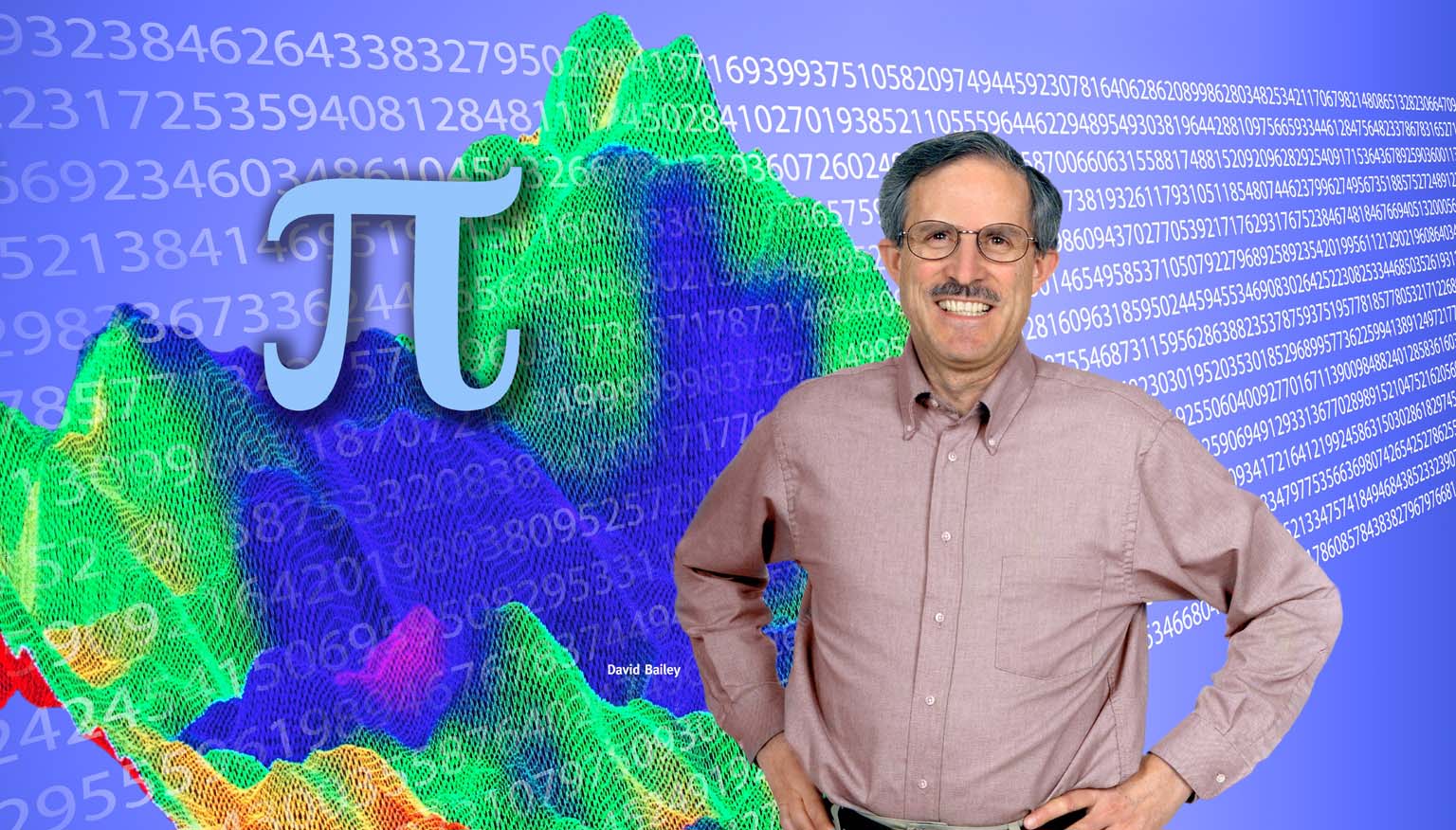
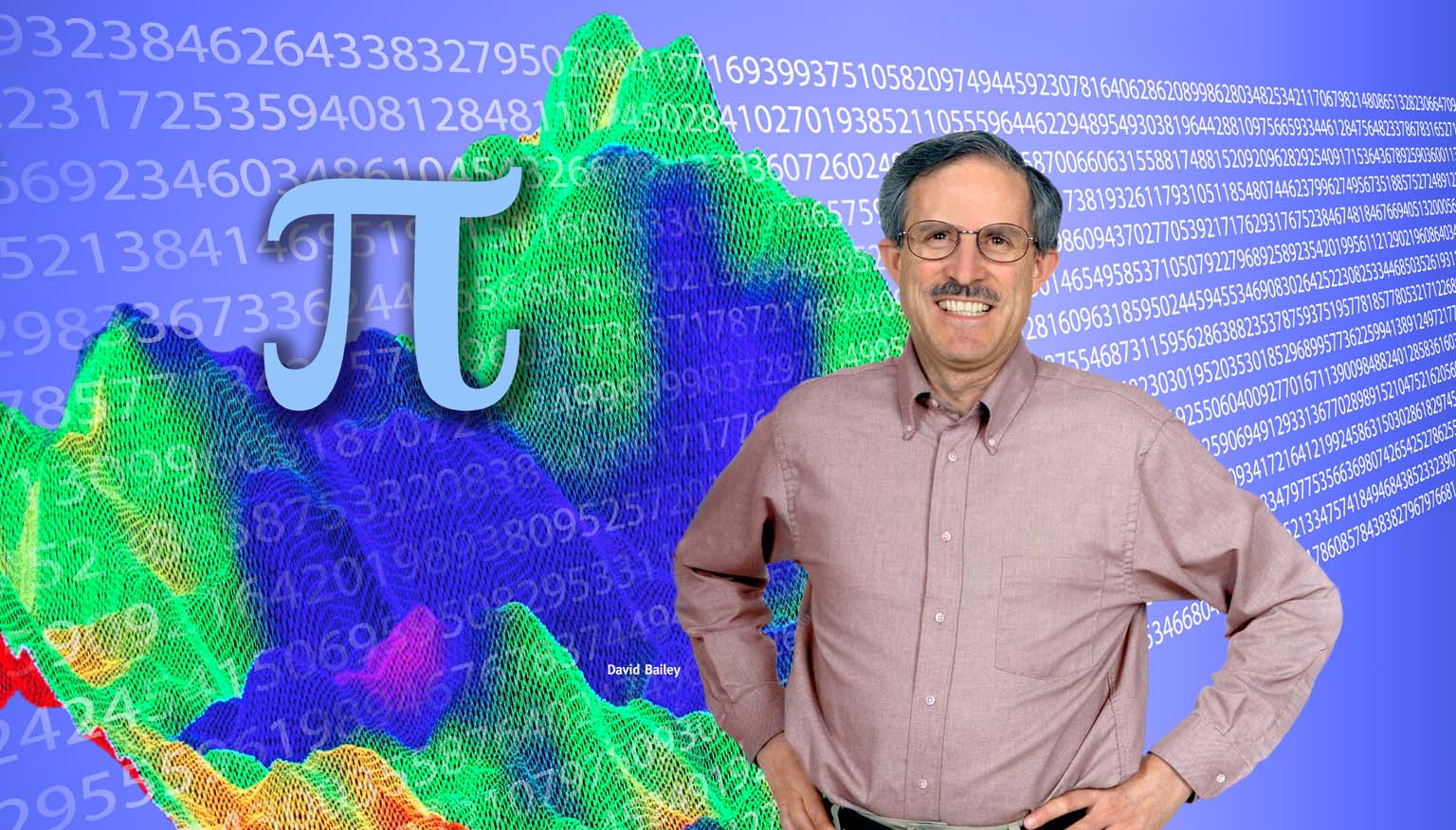
This formula, now known as the "BBP formula for pi", permits one to compute binary or hexadecimal digit of pi beginning at an arbitrary starting position n, without needing to compute any of the first n-1 digits, by means of a simple scheme that requires very little memory. It was originally discovered by Simon Plouffe using a computer program. More recently, Richard Crandall and Bailey have shown that there is a connection between the new pi formula and the centuries-old question of normality (ie, statistical randomness of digits in a certain sense) of pi and various other math constants.
Some additional information on pi:
Press reports. Here are some press reports mentioning Bailey:
Resume. Bailey's detailed curriculum vitae (resume), including a list of publications, is available here:
Disclaimer and copyright. This site is owned and operated by David H. Bailey. Material on this site is provided for research purposes only, and does not necessarily reflect the views or policies of the Lawrence Berkeley National Lab or any other organization. Except where explicitly stated otherwise, all material on this site is copyrighted by David H. Bailey (c) 2024.